

TL;DR:
If you’re just hunting the internet for guitar chord diagrams, here you go.
If you wanna actually know how to USE all the most common guitar chords – and play ‘em without busting your fingers up – read on.
What You’ll Learn
In this article you will learn:
 What IS a chord, really?
 The four most common chord types – power chords, open chords, barre chords, and 7th chords
 Technique tips and fingerings for each chord
Real songs that use each chord
How to play chords all over the neck
The three best rhythm hand techniques for chords
#1What Is a Chord?
If you ask a random guitarist, “Hey, what’s a chord?” you might get an answer like, “It’s when you play a bunch of strings at once.” And while that’s not wrong… it’s not quite right either.
A chord is two or more notes played at once.
Powdered-wig-wearing theory nerds might argue that a chord is three or more notes… but you can just play a power chord at them to scare them away.
#2The Power Chord
Power chords are made up of two notes. They’re lean, they’re mean, and they bring the rock.
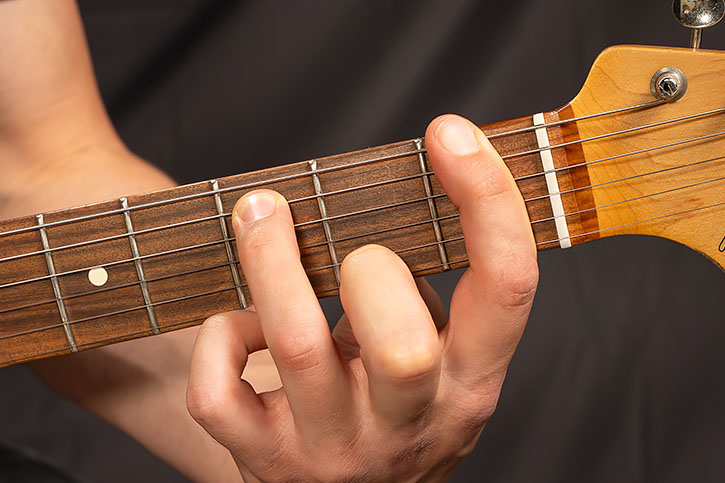
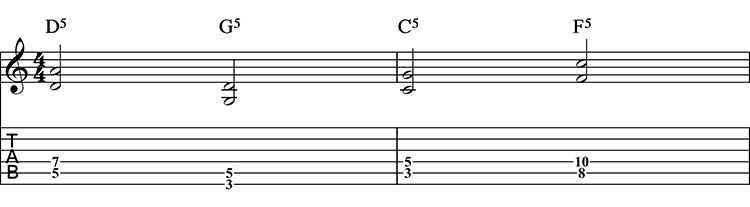
The two most common ways to play power chords are the E string and A string power chords.
For the E string power chord, the root note is on the low E string and you play E and A strings. And for the A string power chord, you guessed it, the root note is on the A string and you play A and D strings.
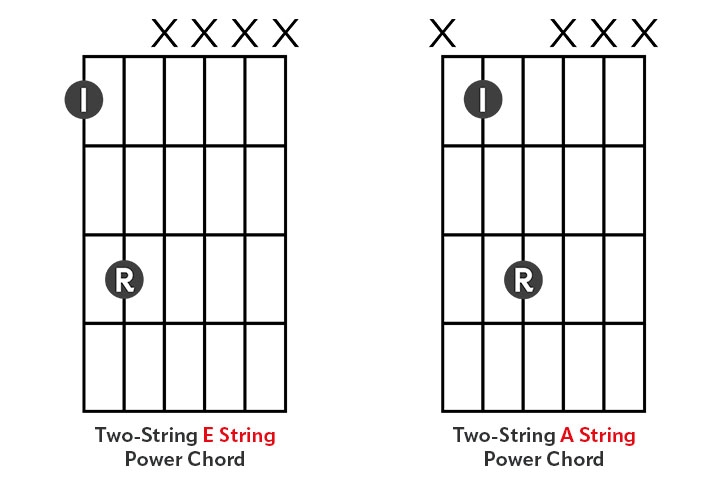
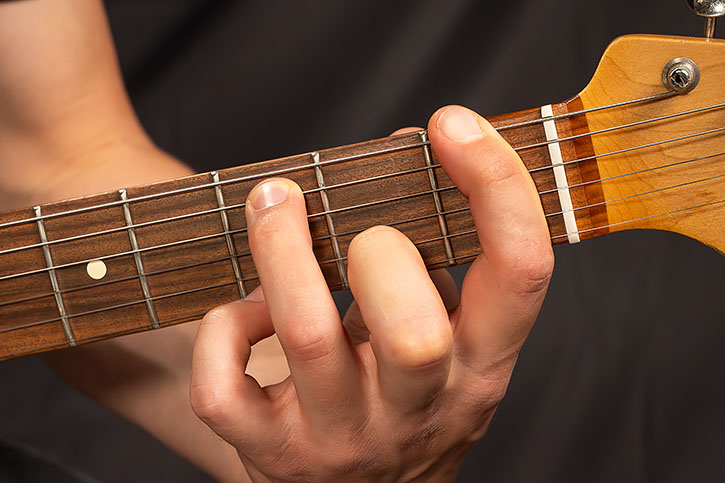
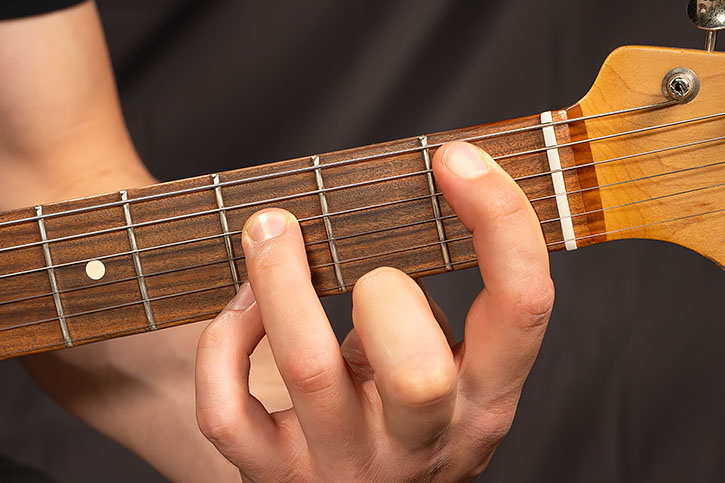
You can also play power chords with three strings, but you’re still only playing two unique notes – the top note is just the higher repeat of the bottom note.
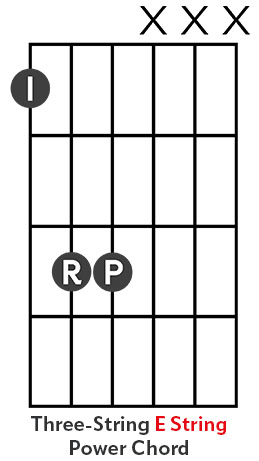
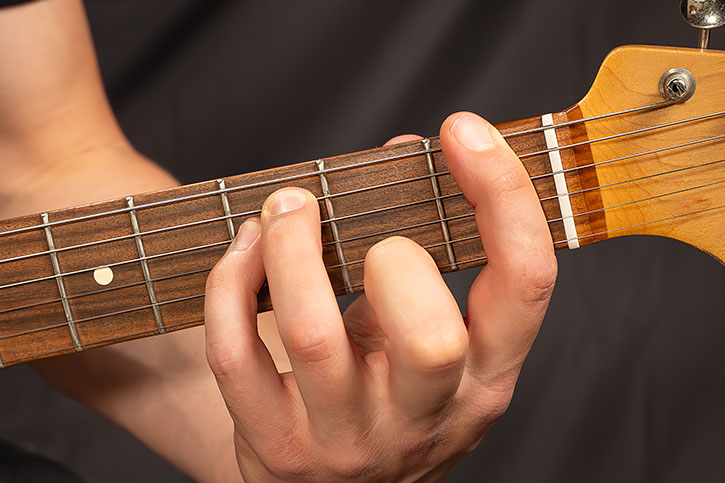
In music theory technical terms, power chords are made up of a root and a 5th.
This means that the chord uses the ROOT and the FIFTH note from a major or minor scale.
And three-string power chords just use an extra high-sounding root note called the “octave” as the top note. So play a root and a fifth together, add another root on top if you want an even thicker sound, and you’ve got yourself a power chord.
The most kickass thing about power chords is that they are movable chords. That means we can move the power chord shape all around the neck to play different power chords. The new root note—the one you’re playing with your index finger—is the new name of the chord.
Songs That Use power Chords
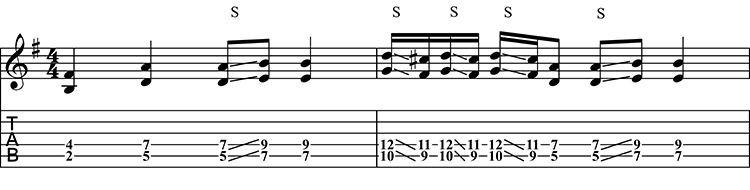
Iron Man 
Tony Iommi uses two-string power chords in the iconic ‘Iron Man’ riff, and makes it feel like a punch to the gut in the best way possible.
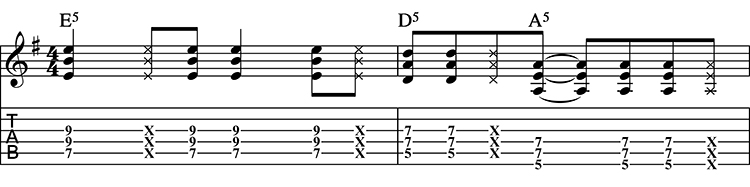
Welcome to Paradise
The riff to Green Day’s ‘Welcome to Paradise’ is all about Billie Joe Armstrong hammering away on some three-string power chords.
Using These Chords
To make your own killer power chord riffs, just move E and A shapes around to any frets you wanna try – almost anything will sound SICK. Just keep your starting notes to the E and A strings, otherwise your power chord shape will get messed up by the tuning of the high strings.
You can also pair power chords with the minor pentatonic scale, if you know it. Use the notes of the minor pentatonic scale as the root notes for your power chords, and instantly unlock massive sounding riffs.

If you just read minor pentatonic and thought “what the heck is that,” then check out my course, Beginner to Kickass. I teach you all the essential guitar fundamentals: riffs, chords, scales, rhythm, and lead. Translation – everything you need to know to tear it up at a jam session and play your favorite songs.
Technique  Tips
Tips
 1. Stretching
- When you first start playing power chords, having your index and ring fingers two frets apart can feel like doing the splits. My fingers still tremble at the memory of their first power chord. But, don’t worry, it’ll start to feel way more normal with time and reps. Promise.
 2. Relaxed Arm
- Good fretting uses your whole arm. Relax your shoulder, and let your elbow hang instead of having it pinned to your side.
 3. Flat Fingers
- When it comes to fretting fingers – you can relax the arch, and let your fingers mute the strings that aren’t in the chord. That way, you can rock with reckless abandon and not worry about playing unwanted strings.
#3Open Chords
Think back to when you first picked up a guitar…
Maybe your cool guitar-playing aunt handed you her axe and showed you a chord or two. Your aunt plays guitar, right? No, just me?
Either way, chances are the first chords you saw were the kind of “everybody knows these” chords we’re talking about here—open chords.
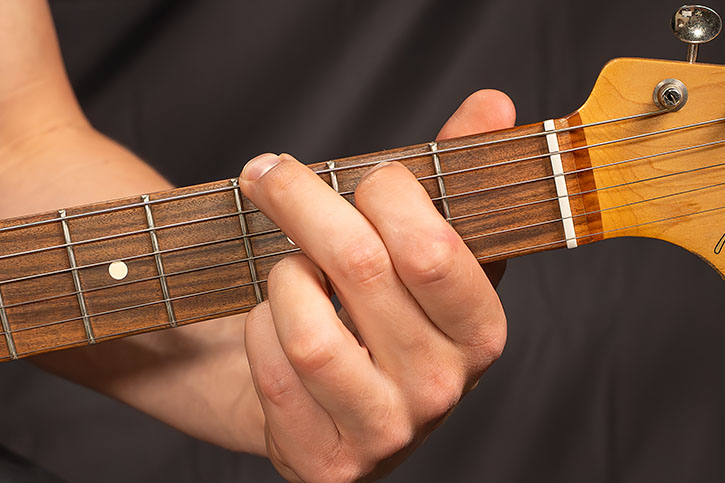
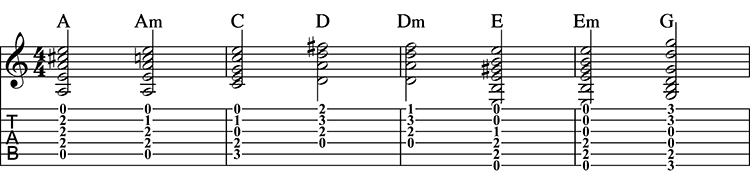
Open chords are chords that use open strings. They’re usually played down by the nut and are generally some of the first chords you learn.
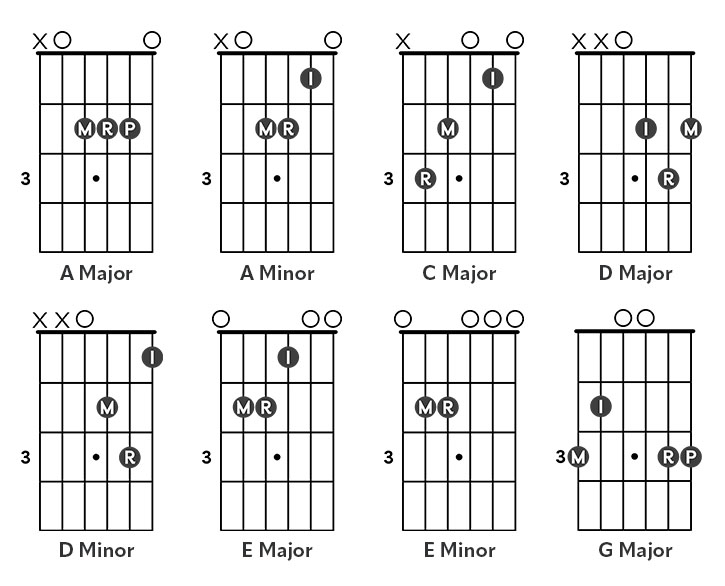
Whether you’re jamming with your buddies around the campfire or serenading your cat, open chords are freakin’ awesome. Cuz once you know these eight chords and a couple strumming patterns, you can play (approximately) a bazillion songs. Here’s how to play them without your hand exploding:
A Major
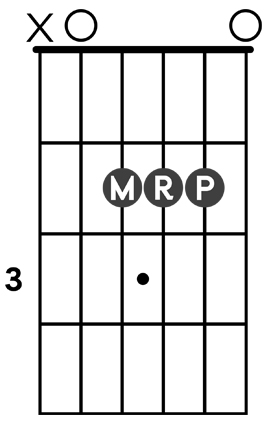
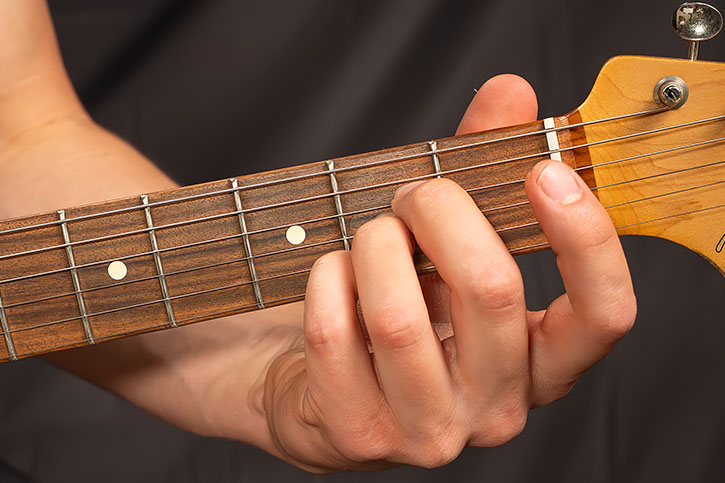
Stack your fingers like a staircase so they can all fit in the second fret.
A Minor
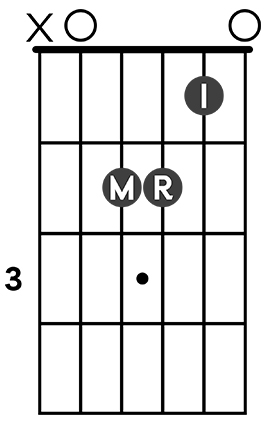
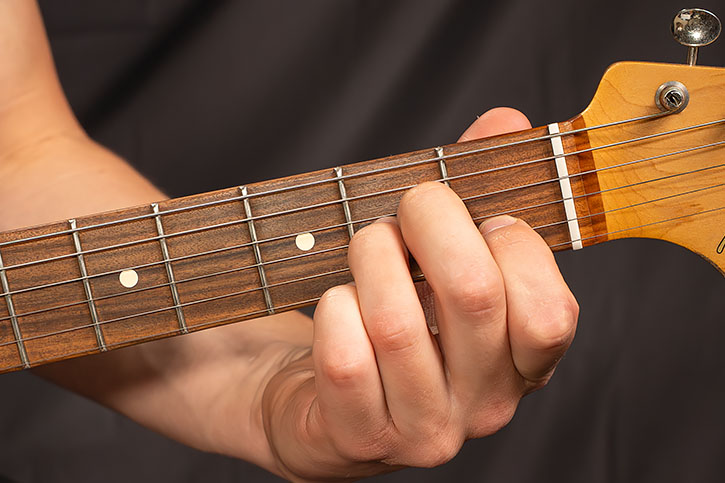
If you hear any muted strings, check your index and ring fingers. They need to be arched tall to avoid touching any other strings.
C Major
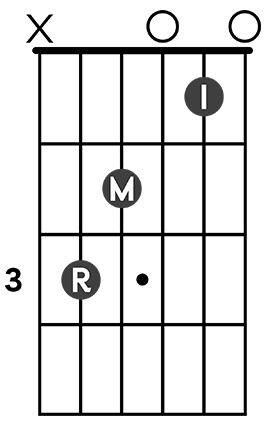
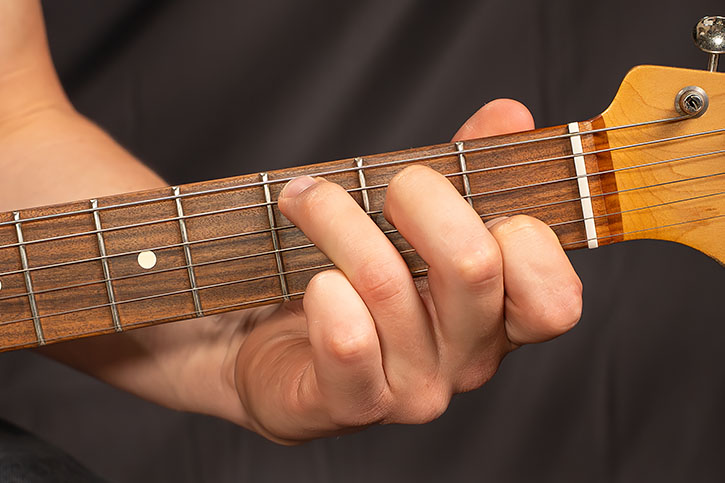
This one’s a big reach for your ring finger. Make sure your index and middle fingers are close to the fret to minimize the stretching your ring finger has to do.
D Major
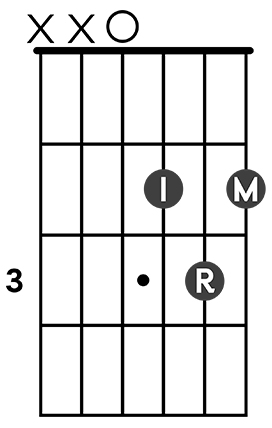
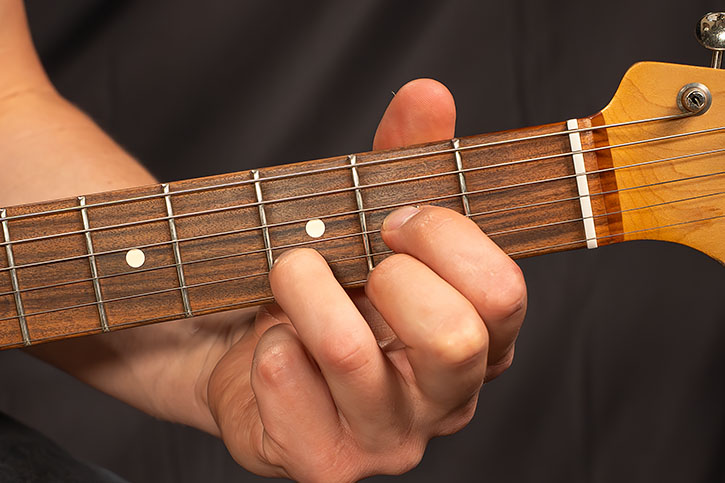
Turn your hand very slightly so your palm opens towards the guitar body. This’ll help you fit all those fingers into that tight little space.
D Minor
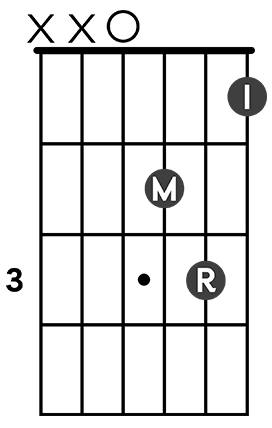
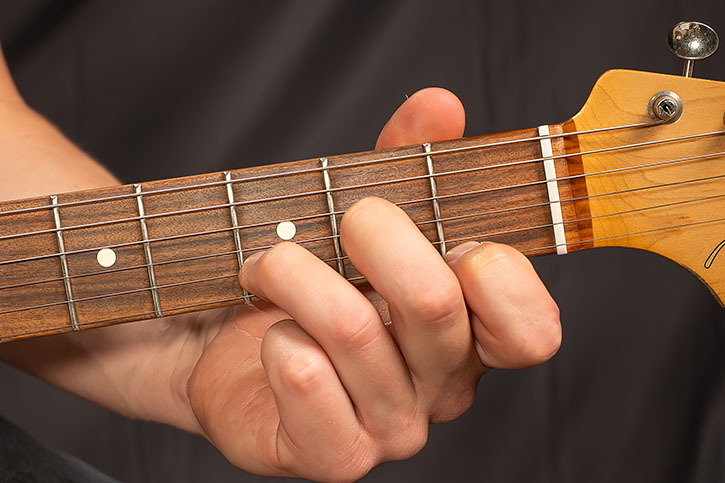
If you have trouble nailing this with your ring finger, try swapping in your pinky finger.
E Major
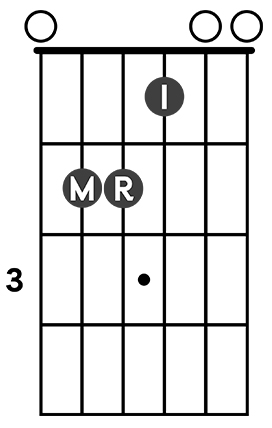
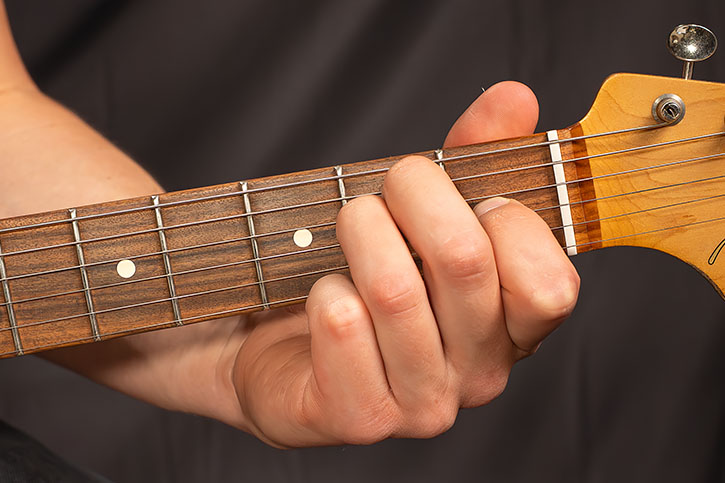
Face your palm up towards the sky, arch your fingers, and fret with your fingertips.
E Minor
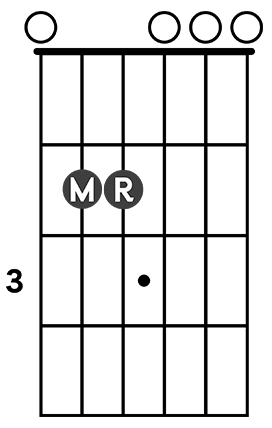
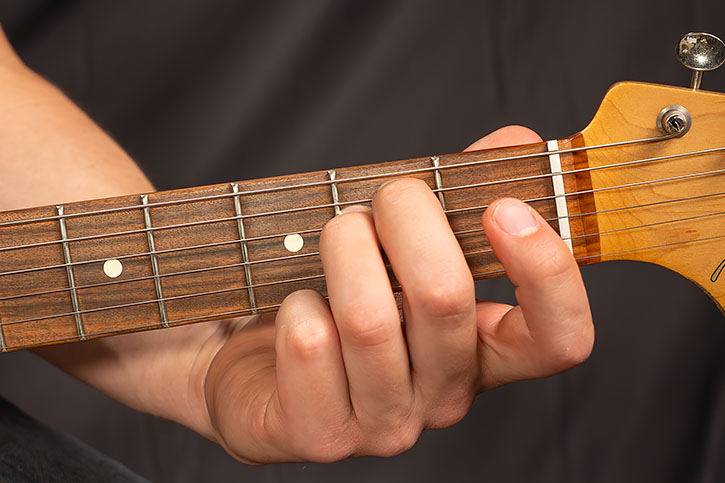
Keep a bit of distance between your palm and the neck to avoid muting the high E string.
G Major
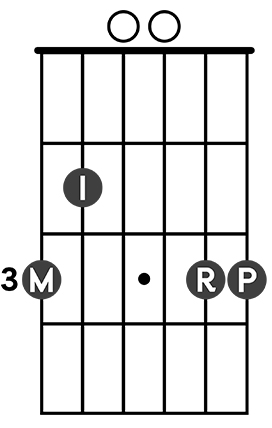
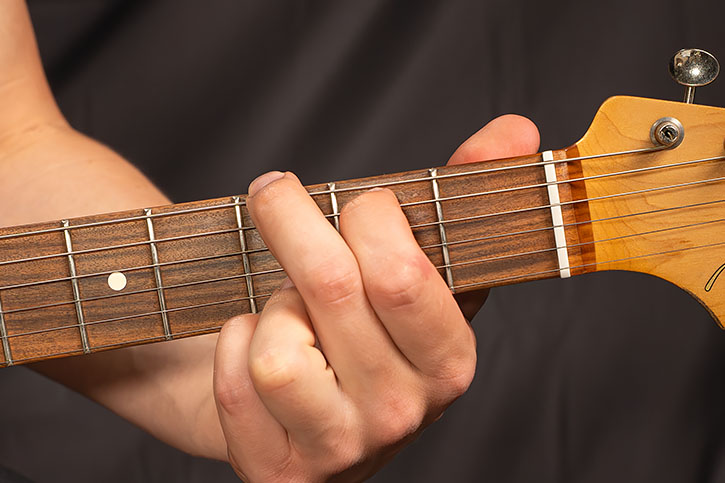
When getting in position, focus on moving your fingers in two groups. Your index and middle fingers move as one to the low strings, and your ring and pinky fingers move together to the high strings.
Songs That Use Open Chords
Dead Flowers
Keith Richards rocks open chords in ‘Dead Flowers’. He keeps things simple with D, A, and G chords.

I Won’t Back Down
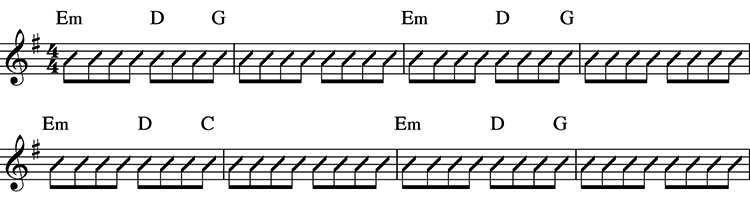
In ‘I Won’t Back Down’, Tom Petty strums Em, D, G, and C for the breezy, yet powerful sound.
How Open Chords Work
To understand how open chords work, we gotta get a wee bit technical and talk about triads. Triads is just a fancier, music theory-ish term to describe the open chords.
Check it – a triad is a three-note chord that uses the first (root), third, and fifth notes of a scale. Major chords, like G and C, are made of the root, third, and fifth of the major scale. Minor chords, like Am and Em, are made of the root, third, and fifth of the minor scale. So… lemme show you what all that jargon means.
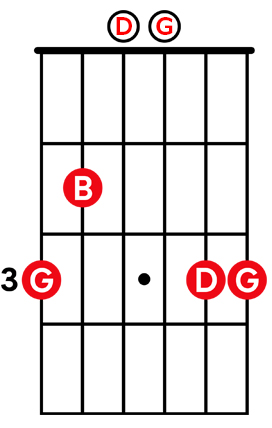
For an open G chord, you strum all six strings, but it’s actually only three notes—G, B, and D with some repeats. And those three notes are the root (G), the third (B), and the fifth (D) of the G major scale.
And same for all the other open chords – you might be strumming 4, 5, or 6 strings, but they all contain only 3 unique note names.
Now if any of that didn’t make sense to you, don’t worry. You can still rock open chords without knowing exactly what makes a triad. But these theory fundamentals will help you become a better guitar player, and I cover that and much more in my Beginner to Kickass course.
#4Barre Chords
Next up, barre chords. These come with a warning: barre chords are tough—much tougher than the open chords we just talked about.
So if you’re brand new to barre chords, be patient with yourself. They take time to really master, but they are so worth it.
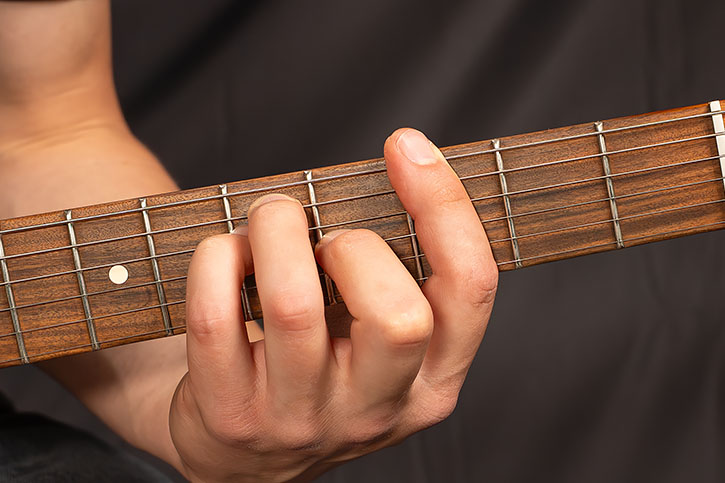
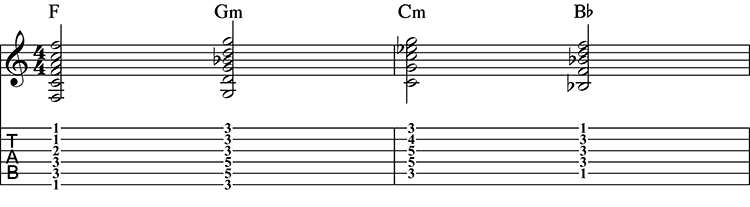
Cuz barre chords are a chord gold mine – once you know the four barre chords shown in this section, you can play every single major or minor chord ever. EVER. They’re movable just like power chords, but they use five or six strings like open chords. Check it out –
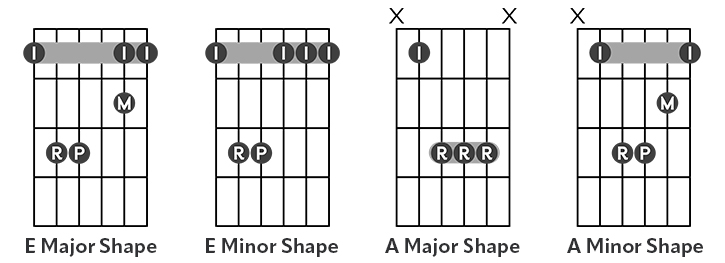
These are the four types of barre chords, and they all have different parent open chords: E major, E minor, A minor, and A major. Here’s how to survive ‘em all:
E Major Shape
An E major open chord uses open strings (low E, B, and high E), so to move this chord shape you need to compensate for the open strings – that’s where the ‘barre’ comes in. “Barring” means that we use one finger to fret multiple strings.
And just like with power chords, the root note gives us the name of the new chord. E is the E major chord’s root note, so if you move everything up one fret, that root note changes to F.
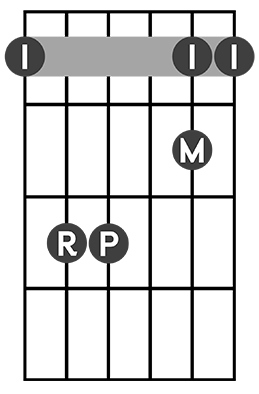
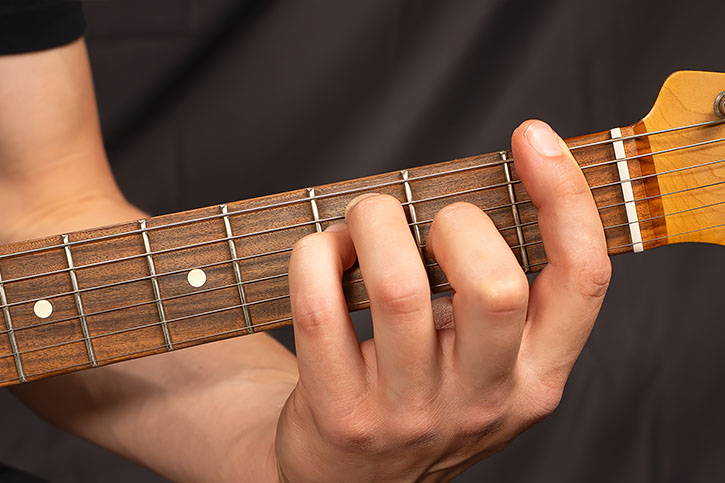
And you could do the same thing starting on any root note on your low E string.
E Minor Shape
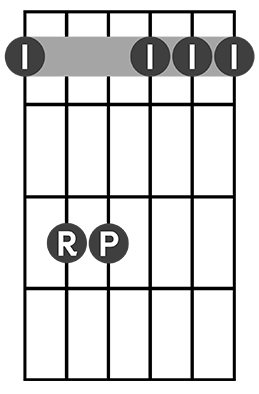
Playing an E minor barre shape is as simple as playing that E major shape and lifting up your middle finger. Here I’m barring the 3rd fret, so the low note of the chord is G which makes this an G minor chord.
A Minor Shape
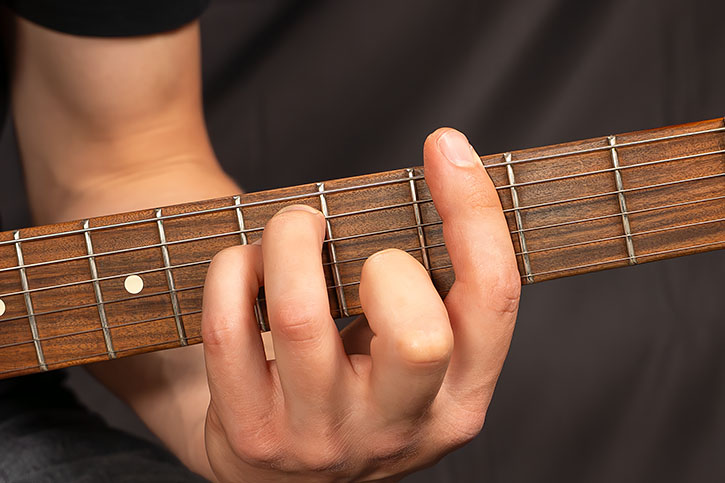
An open A minor chord has an open A and high E string – that’s where your barring finger will have to fill in to make this a moveable chord.
Since the root note for A chords is the open A string, the root note for the moveable barre chord version is on the A string too, and you omit the low E.
In the one I’m playing, the lowest note is on the 3rd fret of the A string, so it’s a Cm chord.
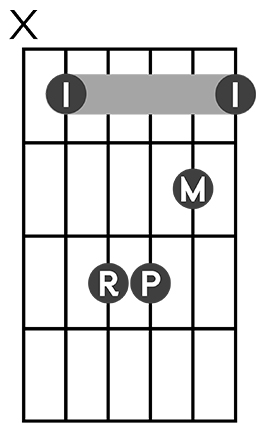
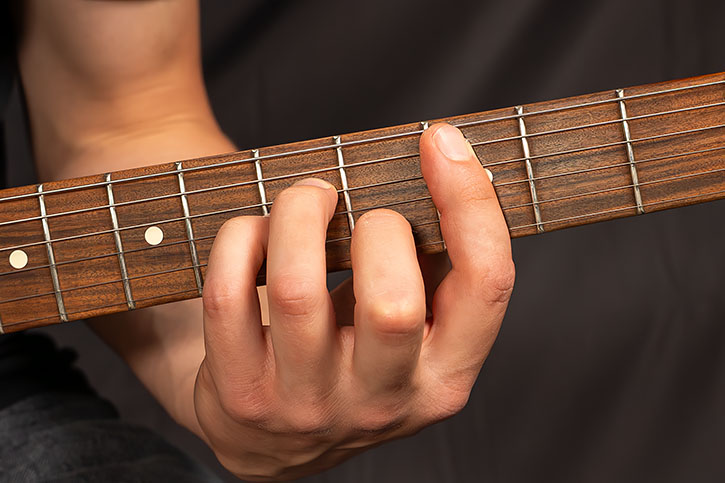
Tip: You can mute the low E string by extending your index finger just enough to touch the low E string. That way you can strum away without having to worry about hitting it accidentally.
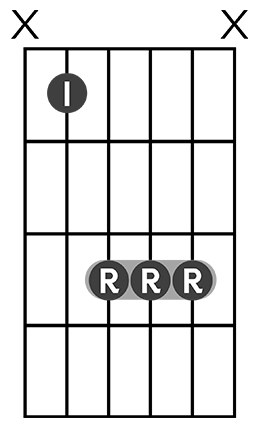
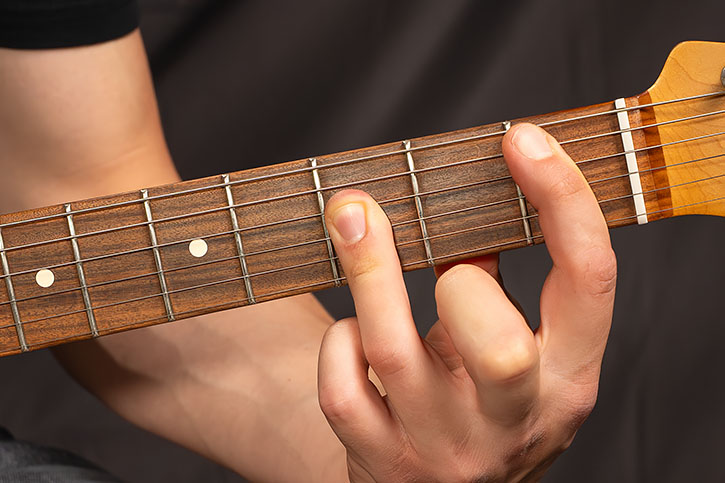
A Major Shape
The A major open chord is usually played with three fingers, but trying to barre across the neck and use all three fingers two frets up is rough.
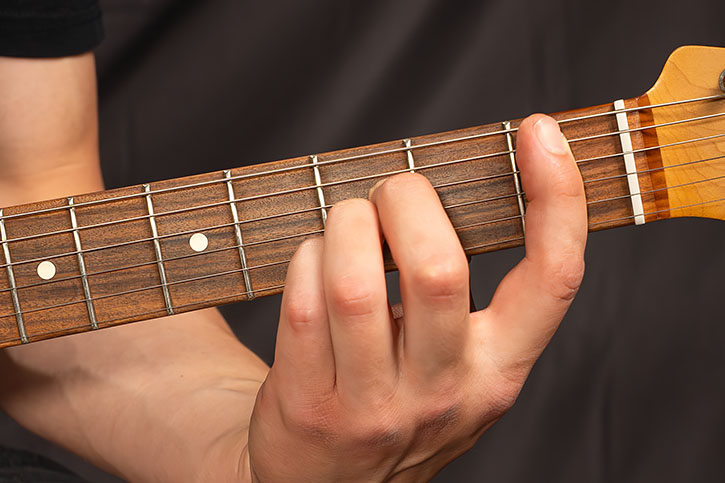
So here’s the hack: barre with your index finger and then barre two frets up on the D, G, and B strings with your ring finger. Here’s me playing a Bb major with my index finger on the first fret.
Songs That Use Barre Chords
Creep
In ‘Creep‘ by Radiohead, Ed O’Brien uses barre chords all throughout the intro and verses.
Where Is My Mind?
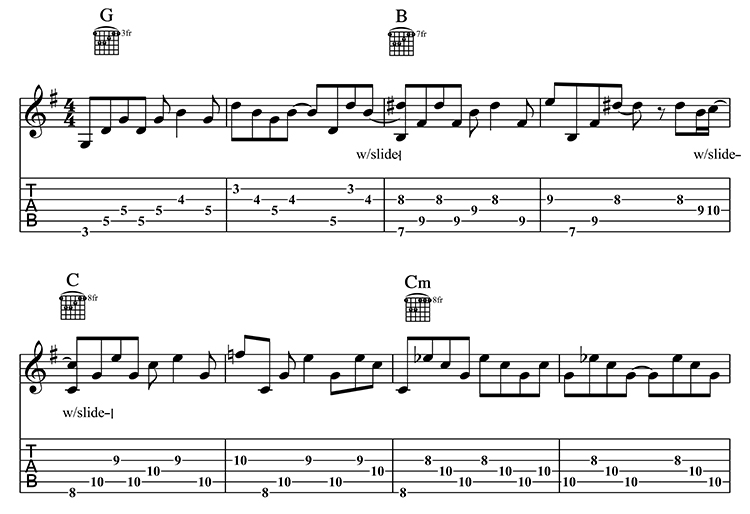
The Pixies’ frontman Black Francis strums E shape and Am shape barre chords throughout ‘Where Is My Mind?‘

Using These Chords
With these four types of barre chords, you can play every single major and minor chord in multiple places on the neck. Just find the root note of the chord you wanna play on either the E or A strings, and, bam, you got it.
Now there is an issue with barre chords… they’re friggin’ hard at first.
But the pain at the beginning is well worth it. It may take weeks. It may take months. But once you have ’em down, you’re a chord monster and you can jam on any song that comes your way. You got this.
Technique Tips
1. Relaxed Arm
- As usual, relax your fretting arm. Let your elbow fall in a natural position, and drop your wrist a bit to help reach all the strings.
2. Roll Your Barre
- Rather than being dead straight, roll your index finger so that you’re fretting with the side.
3. Whole Body Fretting
- Pull in slightly with your fretting arm and your rhythm hand forearm, pushing your belly into the body of the guitar a bit.
4. Be Patient
- Getting frustrated and throwing your guitar through a window doesn’t tend to help with barre chords. Take a break when you’re frustrated or feeling sore, and get back to it when you’re feeling fresh.
#57th Chords
Do you wanna sound sophisticated? Deep? Maybe a little complicated? 7th chords have you covered. They’re mega popular in funk, soul, blues, and jazz, and they can take your chord playing to the next level.
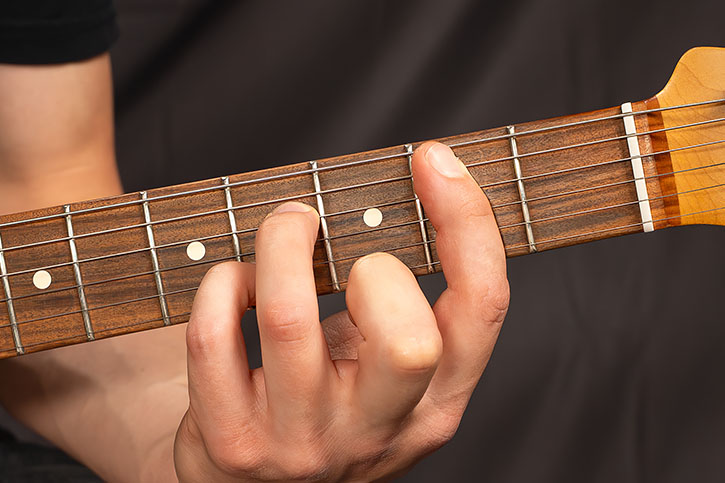
There are three common types of 7th chords: major 7th, minor 7th, and the dominant 7th. We’ll dive into each one of those in a moment, but first, you gotta understand the basics –
7th Chords Theory
The theory of 7th chords picks up right where triad chords left off. Triads are made of a root, third, and fifth of a scale. 7th chords are made up of a root, third, fifth – the triad – and add the seventh note in the scale.
That extra note makes 7th chords sound way more colorful than your basic major and minor triad and allow you to be a way more expressive musician.
Major 7th
The major 7th chord is made up of the root, third, fifth, and seventh notes of a major scale. It sounds kinda melancholic and bittersweet. It’s an emotionally guarded major chord—it knows better than to be happy all the time.
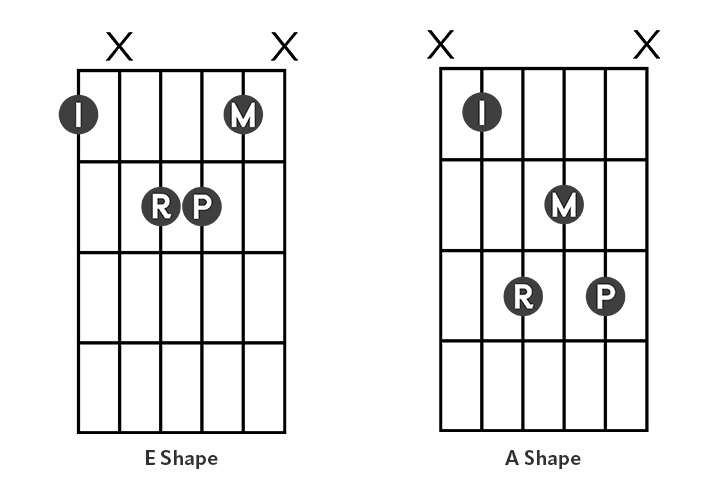
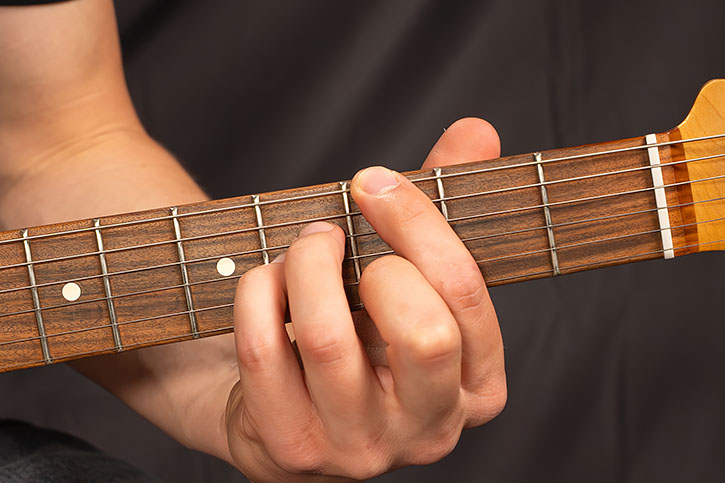
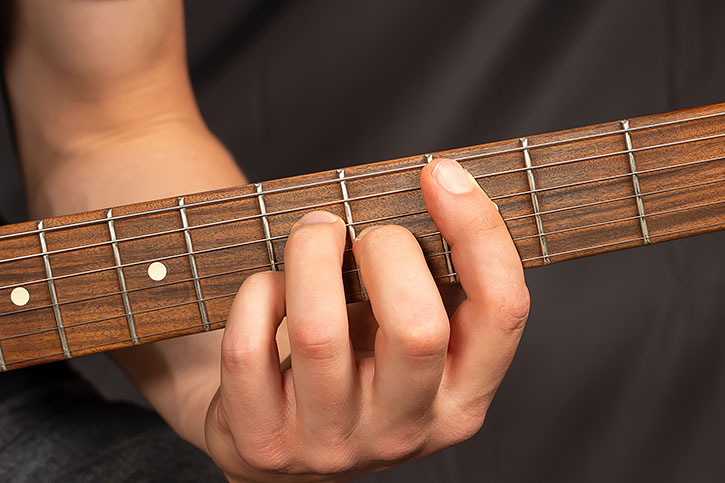
There are a bunch of ways to play a major 7th chord, but two of the popular shapes come from open chords, E and A.
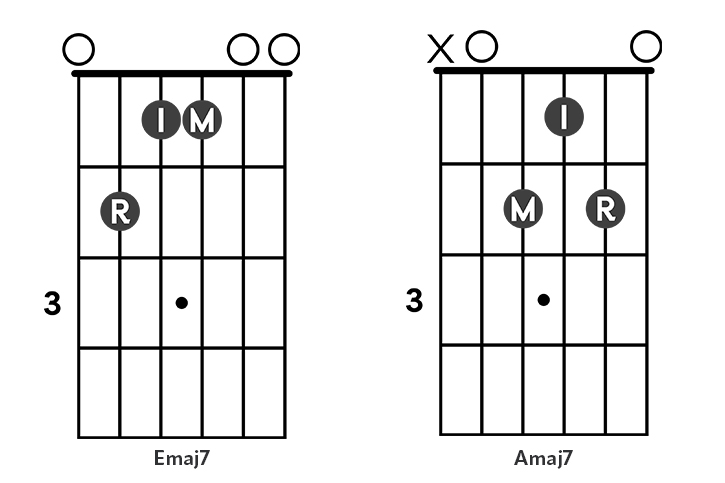
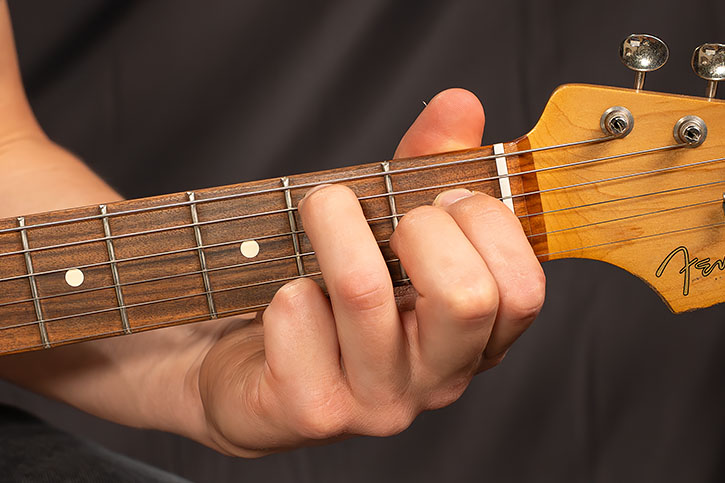
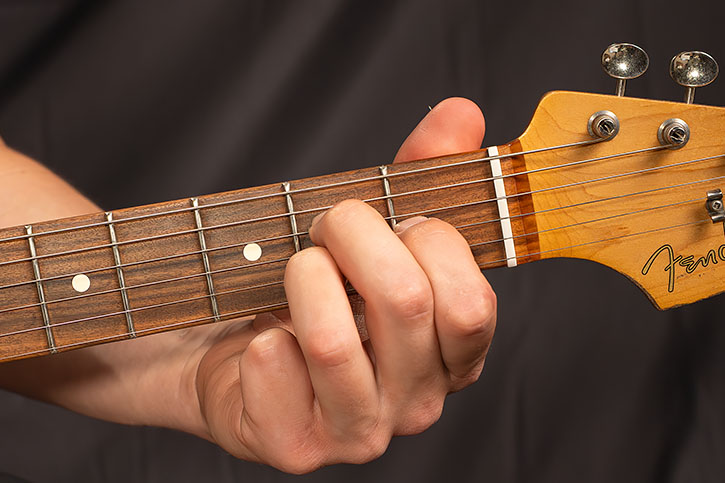
And as barre chords, these too can become movable chords.
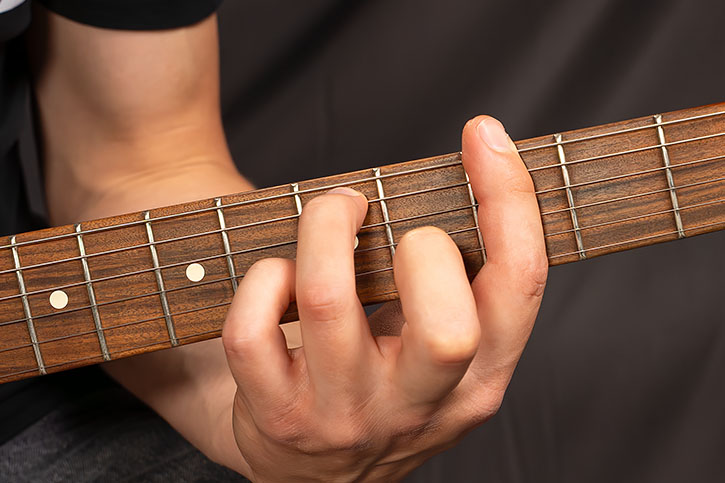
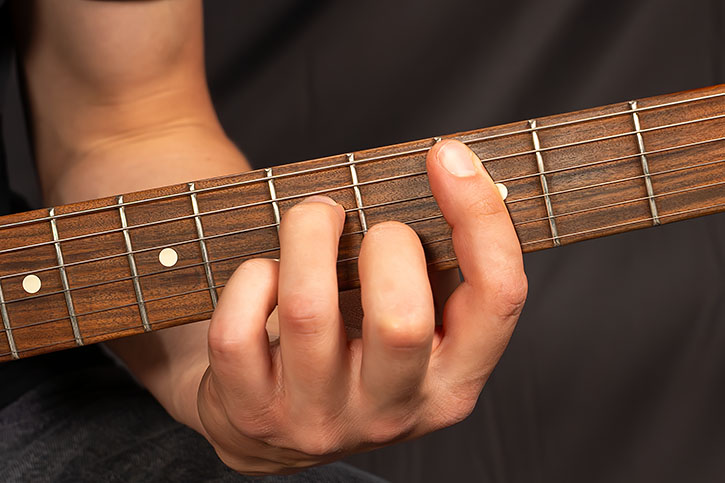
Minor 7th
The minor 7th is made of the root, third, fifth, and seventh of, you guessed it, a minor scale. It sounds like a less sad version of a minor chord. Like a minor chord that’s on the verge of tears, but not all out sobbing. And possibly wearing sunglasses.
Similar to major 7th chords, just look to open Em and Am for the most common minor 7th shapes.
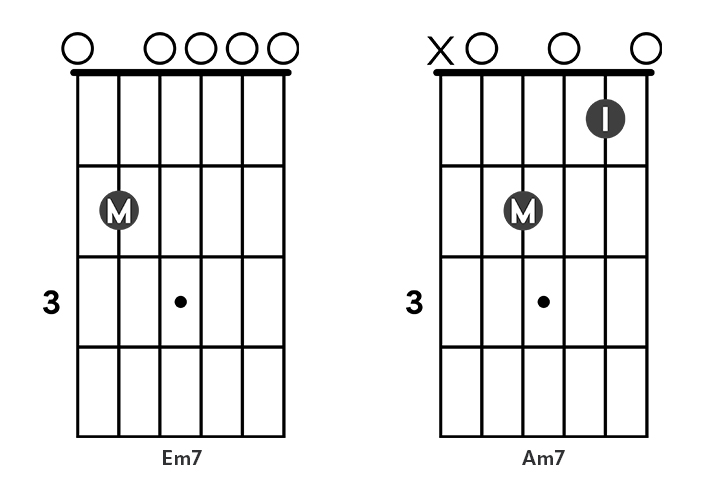
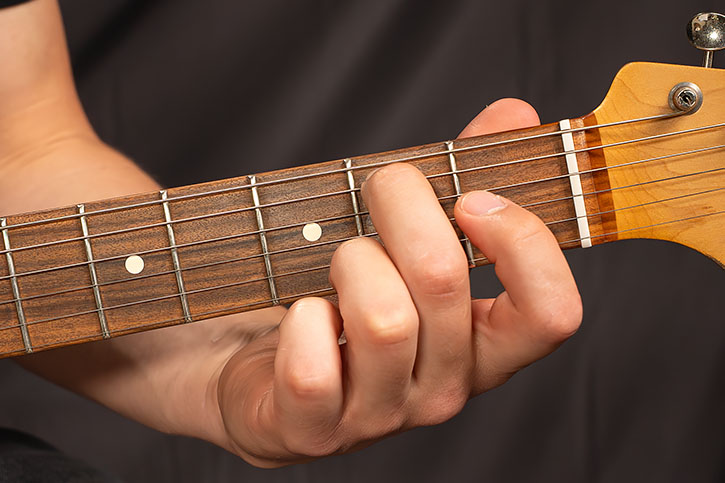
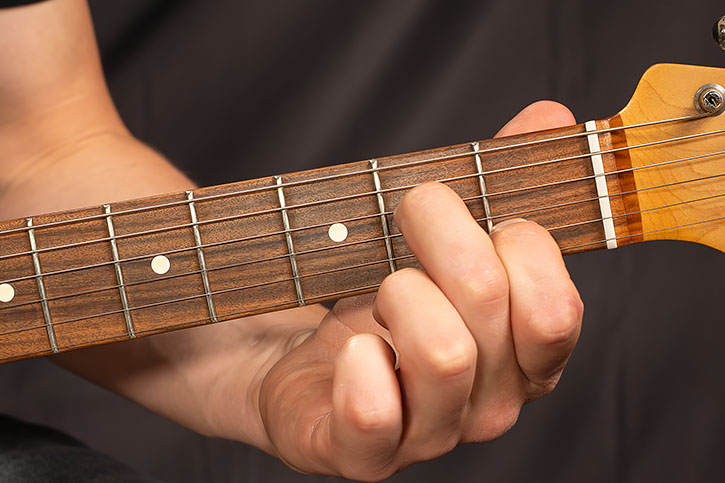
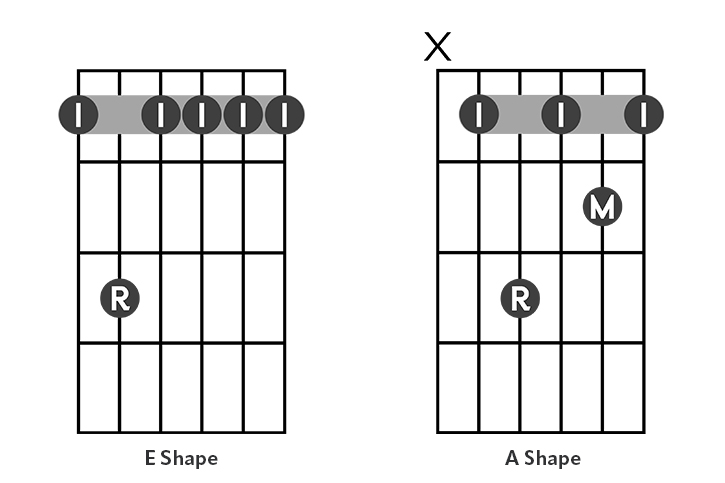
And stick a barre where those open strings were, and you’ve got the moveable versions –
Dominant 7th
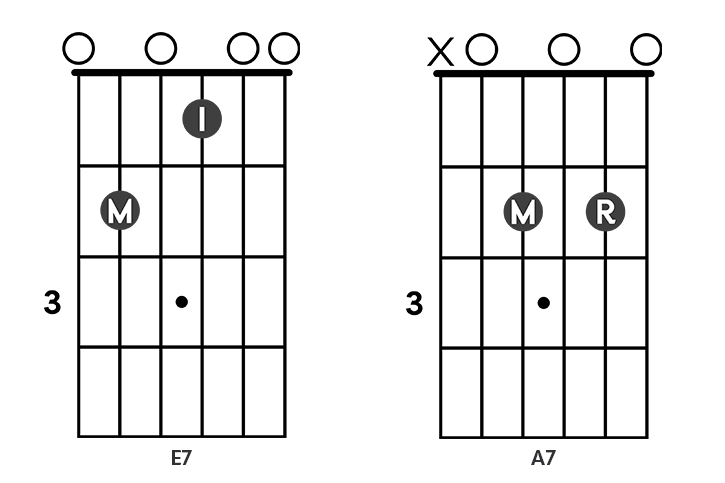
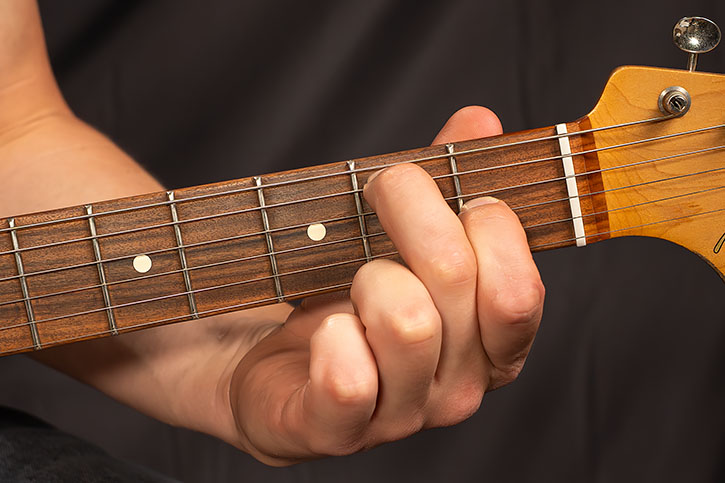
The dominant 7th chord is the scrunchy-face chord. It sounds funky, bluesy, and dissonant.
It’s made up of root, third, fifth, and seventh as well. But the third is from the major scale, and the seventh is from the minor scale. So bluesy.
Just like the other 7th chords, you can play dominant 7th chords using open E and A shapes –
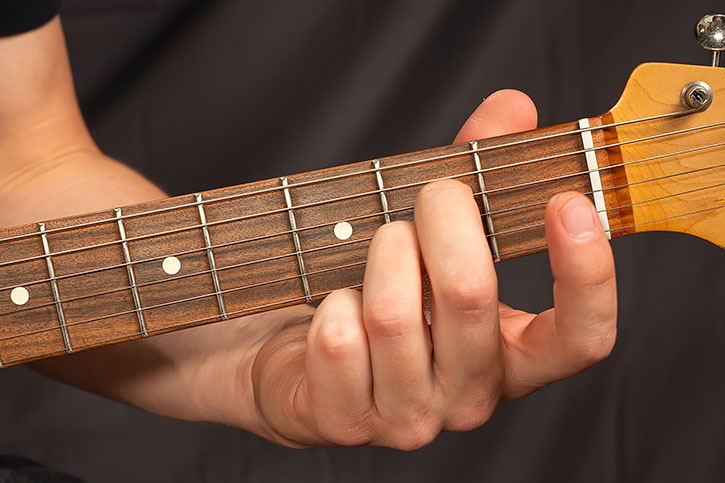
Or moveable versions with a barre –
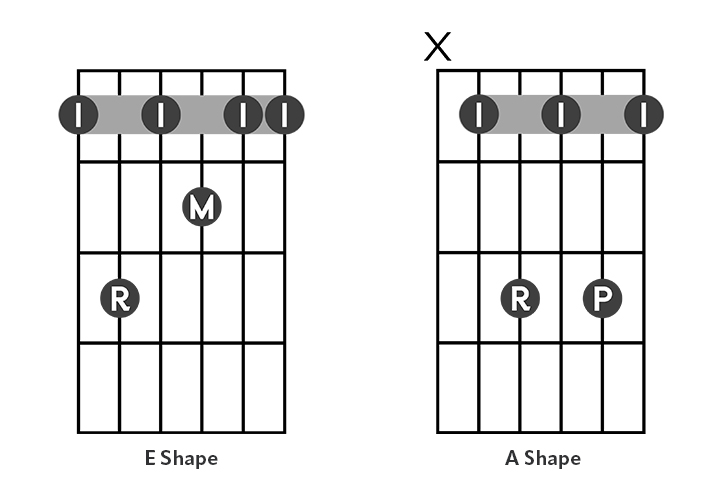
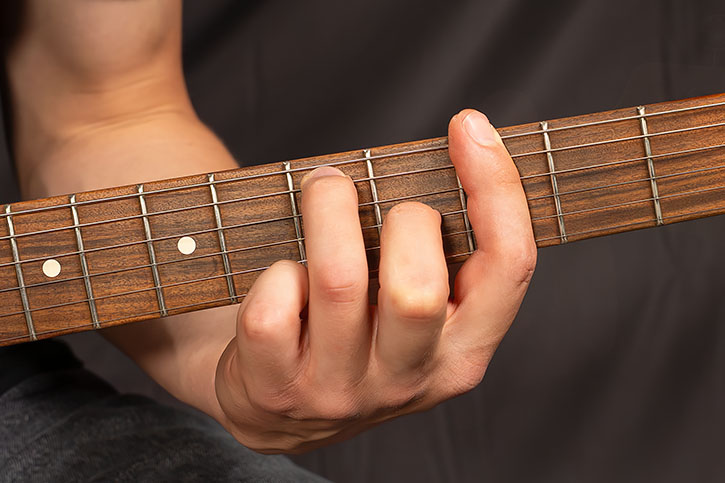
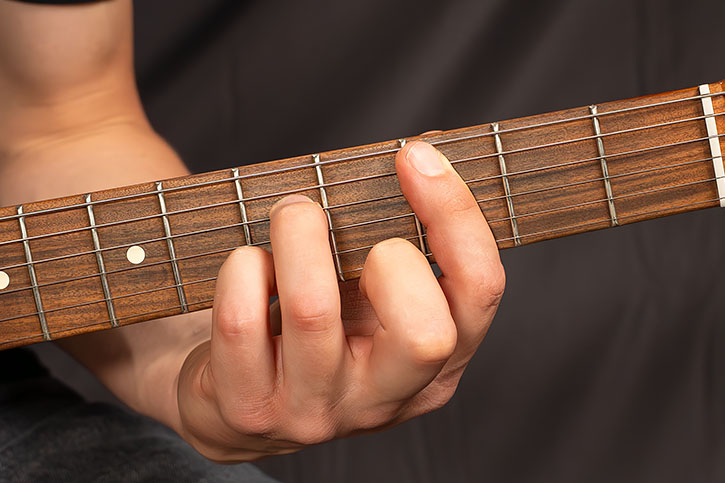
Songs That Use 7th Chords
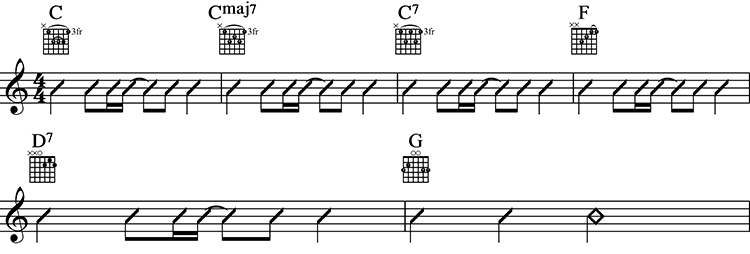
Something
In ‘Something’ by The Beatles, you get to see major 7 and dominant 7 chords in action in the verse.
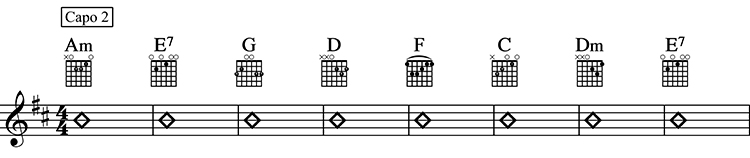
Hotel California
In the Eagles’ classic ‘Hotel California‘, Don Felder perfectly placed a dominant 7th chord to make us feel tension before resolving it at the start of the next round of the progression.
Technique Tips
1. Get Your Barre Solid
- 7th chords depend mostly on your barre chords. If you’re not nailing your barre chords yet, maybe give 7th chords a rest. Pick them back up when your barre chords are feeling solid.
2. Listen to ‘Em
- If you’re not used to them it can take some time for your ears to get a feel for 7th chords, so listen to music that uses them. Blues, funk, and jazz are great places to start.
#6The Rhythm Hand
Cool, so now you know what to do on the fretboard. But how do you actually strum these chords to make them sound cool? Or keep ugly extra strings from ringing and ruining your sound? That’s where your rhythm hand comes in. Here’s how to make sure your chords always sound locked in and jam ready.
Strumming
Let’s start with the obvious—strumming. You can strum every chord in this article with any simple, consistent pattern to create a starting point for a song or jam. But strumming sounds BAD if you’re not synced up with the song’s rhythm…
For the most part, we play music in 4/4 time, meaning each measure has four beats: 1, 2, 3, 4, 1, 2, 3, 4…
So long as you count to four along with the pulse of the song, you can play a tight-sounding strumming pattern, and any drummer you’re playing with will love you.
The basic starting place for any killer strumming pattern is placing your down strums on the numbered beats (1, 2, 3, 4) and your up strums on the “ands” that come between them.
But you don’t have to play“down up down up down up down up” every time – you can finesse your strumming patterns a bit by not strumming on some of those beats.
Some strumming patterns for you to try:
- D DU UDU [1 2+(3)+4+]
- D DU D DU [1 2+3 4+]
- DUDU UD [1+2+(3)+4]
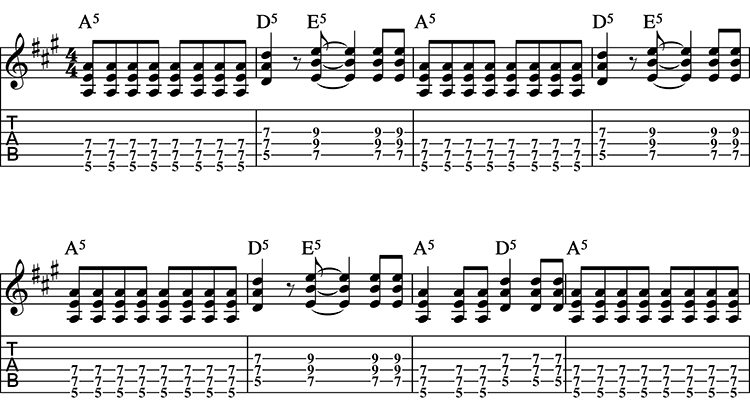
Playing all down strums can also be a killer angsty vibe, especially when paired with power chords.
Songs That Use Strumming
Bad Moon Rising
In ‘Bad Moon Rising‘, John Fogerty sticks with simple down up strums to play the intro.

Blitzkrieg Bop
Johnny Ramone’s playing in ‘Blitzkrieg Bop‘ uses a super fast, all down strum strumming pattern for that angsty Ramones’ feel.
Muted Strum
Sometimes simple strumming can sound a little…simple. If you’re getting bored with your easy breezy down-up strumming, you can spice things up by throwing in some muted strums.
Mixing normal strums with muted strums can help your chords *pop* more. They add attitude, grit, and a percussive growl that clearly says ‘I play guitar and I’m a badass.’
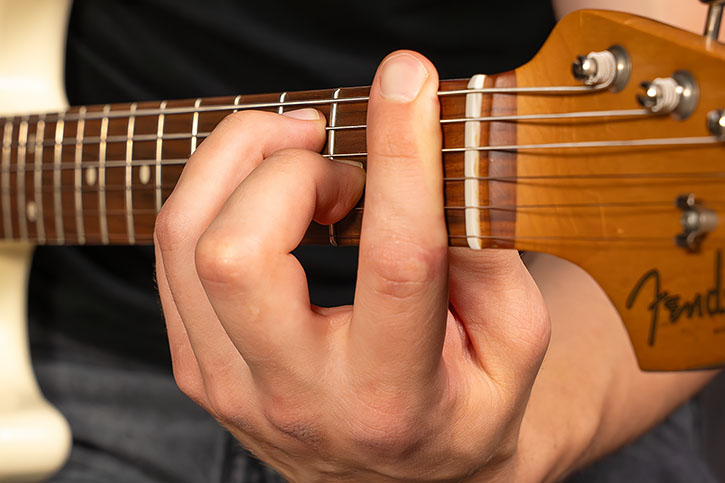
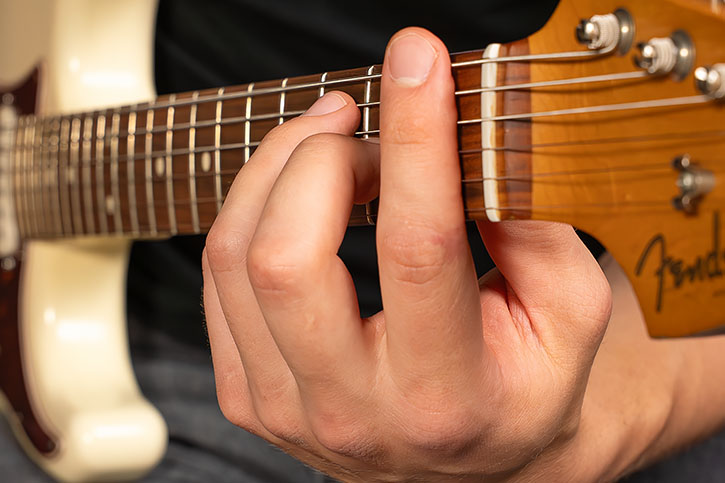
For a muted strum, use your fretting hand to do the muting. Just lay your fingers across the strings without pressing down—strum—and you’ve got a muted sound.
They go hand in hand with barre chords and power chords (pun very much intended), since all you have to do is slightly release your fretting pressure. Then bam—you’ve got a muted strum, and your hand is still in position, ready for the next chord.
Songs That Use Muted Strums
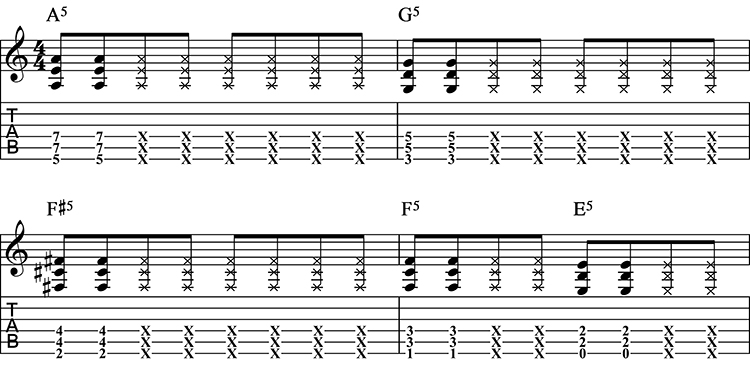
Brain Stew
In ‘Brain Stew’, Green Day’s Billie Joe Armstrong plays muted strums mixed with power chords in the chorus to add a chunky, percussive grit to the climax of the tune.
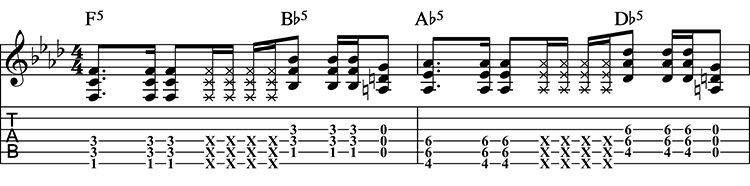
Smells Like Teen Spirit
Kurt Cobain’s muted strums in ‘Smells Like Teen Spirit’ are the glue that turn 4 power chords into the most iconic riff of the last 35 years.
Arpeggios
Arpeggios – the strange Italian word that holds the secret to getting way more flavor out of your chord shapes. Like… I dunno, pasta sauce or something.
So what are they? An arpeggio just means playing the notes of a chord one at a time instead of in one big strum.
So if you play an Am chord, it means you play all the notes of Am together. If you play an Am arpeggio, it means you play the notes of Am one at a time.
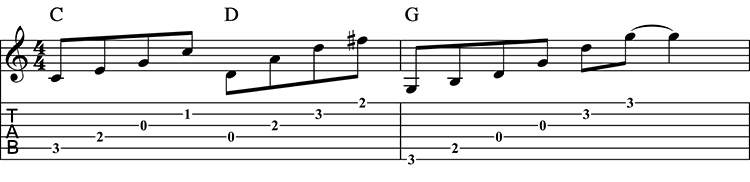
When you compare them to strummed chords, arpeggios sound a little more airy and delicate. They’re killer for giving a chord progression more depth or if you’re after a more intimate style of playing.
Songs That Use Arpeggios
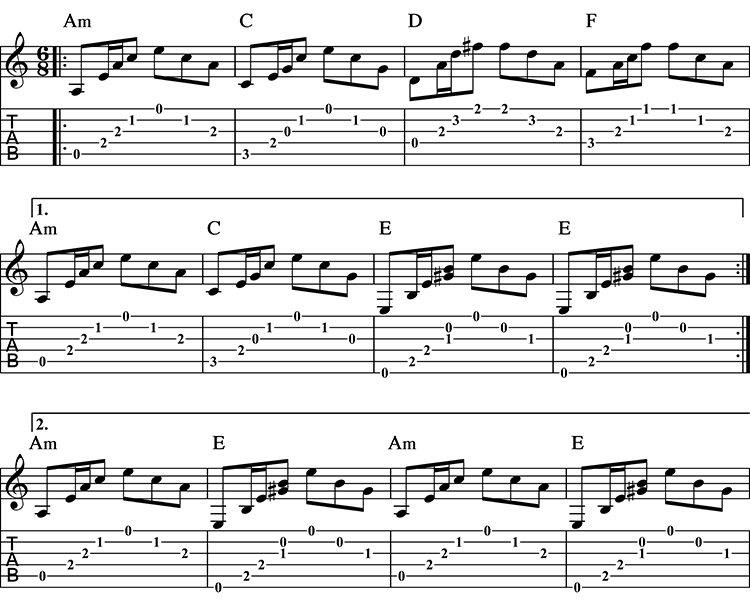
House of the Rising Sun
In ‘House of the Rising Sun‘, Hilton Valentine of the Animals arpeggiates the chords for the signature riff that plays throughout the song.
Californication
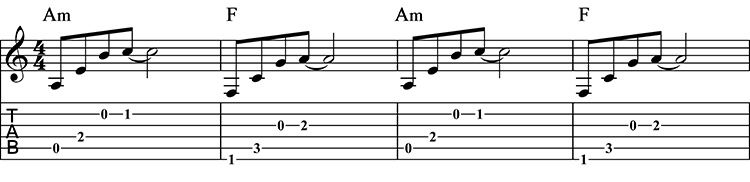
John Frusciante uses arpeggios in the riff for the late 90s Red Hot Chili Peppers classic, ‘Californication‘.
Conclusion
Congrats. You know all the guitar chords. Or at least, you’ve seen them on a page.
But if you really wanna MASTER common guitar chords, you need repeated, deliberate practice to get your fingers to actually do the thing. And a lot of people never get past this hurdle…
Which is why I hacked the mainframe and figured out a foolproof method for beginners to learn chords in my comprehensive course, Beginner to Kickass.

'%3e%3cg id='Final-Copy-2_2_' transform='translate(1275.000000, 200.000000)'%3e%3cpath class='st0' d='M7.4,12.8h6.8l3.1-11.6H7.4C4.2,1.2,1.6,3.8,1.6,7S4.2,12.8,7.4,12.8z'/%3e%3c/g%3e%3c/g%3e%3c/g%3e%3cg id='final---dec.11-2020'%3e%3cg id='_x30_208-our-toggle' transform='translate(-1275.000000, -200.000000)'%3e%3cg id='Final-Copy-2' transform='translate(1275.000000, 200.000000)'%3e%3cpath class='st1' d='M22.6,0H7.4c-3.9,0-7,3.1-7,7s3.1,7,7,7h15.2c3.9,0,7-3.1,7-7S26.4,0,22.6,0z M1.6,7c0-3.2,2.6-5.8,5.8-5.8 h9.9l-3.1,11.6H7.4C4.2,12.8,1.6,10.2,1.6,7z'/%3e%3cpath id='x' class='st2' d='M24.6,4c0.2,0.2,0.2,0.6,0,0.8l0,0L22.5,7l2.2,2.2c0.2,0.2,0.2,0.6,0,0.8c-0.2,0.2-0.6,0.2-0.8,0 l0,0l-2.2-2.2L19.5,10c-0.2,0.2-0.6,0.2-0.8,0c-0.2-0.2-0.2-0.6,0-0.8l0,0L20.8,7l-2.2-2.2c-0.2-0.2-0.2-0.6,0-0.8 c0.2-0.2,0.6-0.2,0.8,0l0,0l2.2,2.2L23.8,4C24,3.8,24.4,3.8,24.6,4z'/%3e%3cpath id='y' class='st3' d='M12.7,4.1c0.2,0.2,0.3,0.6,0.1,0.8l0,0L8.6,9.8C8.5,9.9,8.4,10,8.3,10c-0.2,0.1-0.5,0.1-0.7-0.1l0,0 L5.4,7.7c-0.2-0.2-0.2-0.6,0-0.8c0.2-0.2,0.6-0.2,0.8,0l0,0L8,8.6l3.8-4.5C12,3.9,12.4,3.9,12.7,4.1z'/%3e%3c/g%3e%3c/g%3e%3c/g%3e%3c/g%3e%3c/svg%3e) Privacy Choices
Privacy Choices
 Beginners Course
Comments
Got something to say? Post a comment below.